Last updated: 2026-09-07
Commercial Refrigeration Oklahoma City repairs walk-in coolers across Oklahoma City for restaurants, bars, groceries, convenience stores, schools, and food distributors. A walk-in that will not hold temperature has one of a short list of causes: a dirty or failing condenser, an evaporator fan or defrost problem packing the coil with ice, a refrigerant undercharge from a slow leak, a stuck expansion valve, or a control that has drifted. The first visit isolates which one, restores cooling where the parts are on the truck, and gives you a written price for anything that has to be ordered.
What we do on the first visit
The technician logs the box temperature and how it is trending, then works the system in the order that finds most faults fastest: line voltage and the temperature control, condenser coil condition and condenser fan operation, evaporator fans and the defrost cycle, then refrigerant pressures and superheat to judge the charge and the metering device. Condenser cleaning, a fan motor, a defrost control, a thermostat, or a charge correction are usually same-visit fixes. A compressor, an evaporator coil, or a case-specific board is quoted in writing and scheduled.
Why Oklahoma City walk-in coolers fail in summer
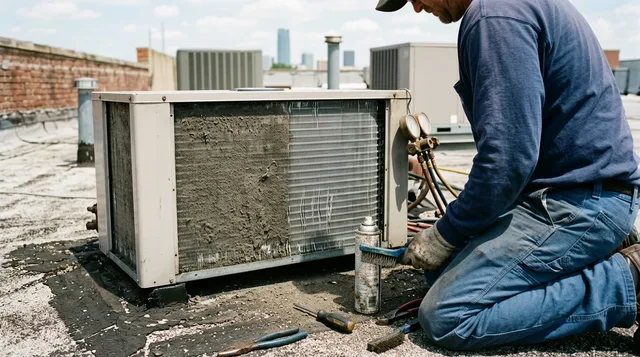
Most no-cooling calls between June and September trace back to the condenser. OKC runs 95–100 °F-plus for weeks, and rooftop or alley condensers also load up with cottonwood seed and wind-blown grit every spring. A coil that is half-blocked cannot reject heat, head pressure climbs, the compressor runs hot and long, and the box slowly loses ground on the hottest afternoons. Cleaning the condenser, verifying the condenser fans and any head-pressure control, and checking the charge fixes a large share of summer failures for a fraction of a compressor's cost, which is why it is the first thing the technician checks.
The ice problem: defrost, airflow, and door heat
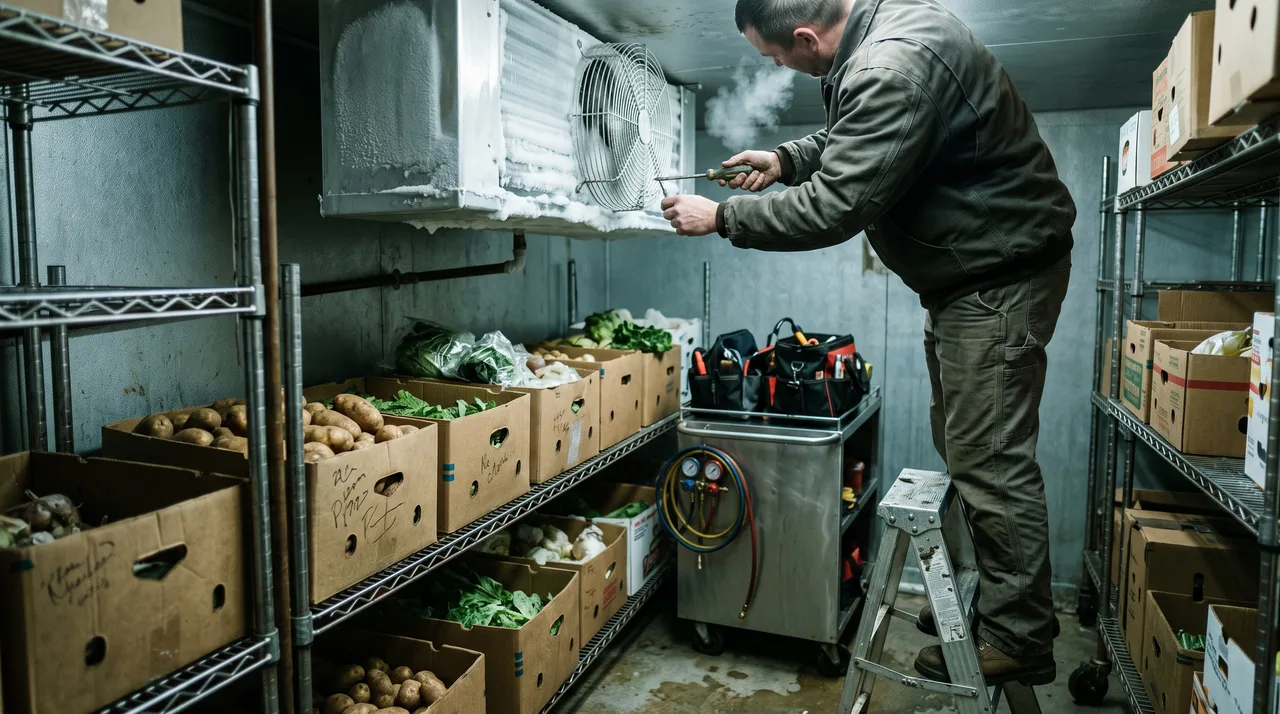
A coil that freezes into a block is almost never low on refrigerant. It is usually a defrost fault, an evaporator fan that has stopped, a door left open or with a failed closer or gasket, or a blocked drain line that refreezes. A walk-in defrost cycle is timed to melt frost several times a day; when the timer, heater, or termination sensor fails, frost builds until it blocks airflow and the box goes warm even though the compressor is running fine. The technician checks defrost initiation and termination, heater amp draw, fan operation, and the drain line and pan heater, then corrects the specific failure rather than just chipping the ice.
Slow refrigerant leaks and why 'just add gas' fails
If the charge is low there is a leak, and under EPA Section 608 the leak has to be found and repaired, not just topped off, on equipment above the regulated charge size. Common leak points on OKC walk-ins are flare fittings on the evaporator, Schrader cores, corroded copper where a line set runs through a wet wall or across a hot roof, and the compressor's own service valves. The technician isolates the leak with an electronic detector and, where needed, nitrogen and bubbles, repairs it, pulls a proper vacuum, and charges by weight so the system runs at the right superheat instead of being flooded or starved.
Insurance and payment
Repairs are quoted flat, with the diagnostic fee stated on the phone and applied toward the work. For failures that spoil inventory, many business policies carry equipment-breakdown and spoilage coverage; Commercial Refrigeration Oklahoma City supplies an itemized invoice, the written diagnosis, and a temperature log so a claim has the documentation an adjuster asks for. Financing conversations for a full system replacement are handled through the installation service, not bundled into a repair invoice.
What's included
- Flat-rate diagnostic quoted before the visit and applied to the repair
- Full check of power, temperature control, condenser, evaporator, defrost and drain
- Refrigerant pressure and superheat/subcooling readings to judge charge and metering
- Condenser and evaporator coil cleaning where that is the fault
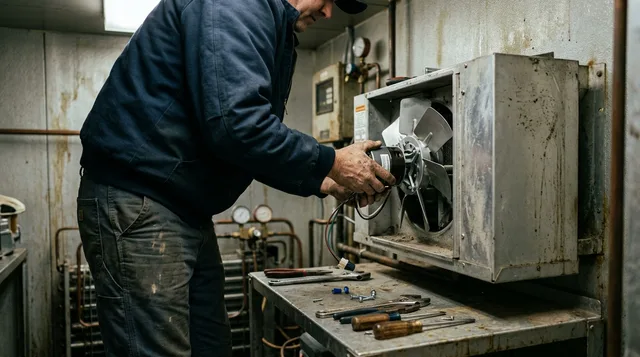
- Same-visit replacement of stocked parts: fan motors, capacitors, contactors, controls, TXV power heads, gaskets
- EPA Section 608 leak isolation and repair, evacuation, and charge by weight
- Defrost cycle test and correction: timer/control, heater, termination sensor, drain-line and pan heater
- Written price and schedule for any compressor, coil, or control board that must be ordered
Symptoms we get called for
- Box temperature drifting above 40 °F or not recovering after a delivery
- Evaporator coil frozen into a solid block of ice
- Condensing unit running constantly and never cycling off
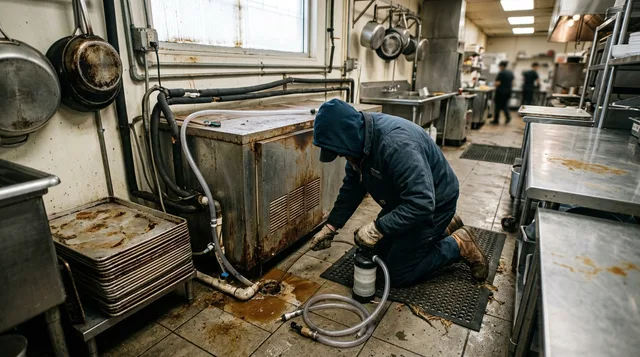
- Water on the floor inside the box or under the door
- Warm air from the evaporator fans or fans not spinning
- Ice on the door frame, torn gaskets, or a door that won't seal