Last updated: 2026-09-07
Commercial Refrigeration Oklahoma City performs commercial refrigerant leak detection and repair across Oklahoma City on walk-ins, reach-ins, cases, ice machines, and rack systems. If a system is low on refrigerant, it has a leak, and EPA Section 608 requires that leak to be found and repaired rather than repeatedly topped off on equipment above the regulated charge threshold. The process is a structured leak search, a durable repair, a proper evacuation, and a charge measured by weight so the system runs at its designed superheat.
What we do on the first visit
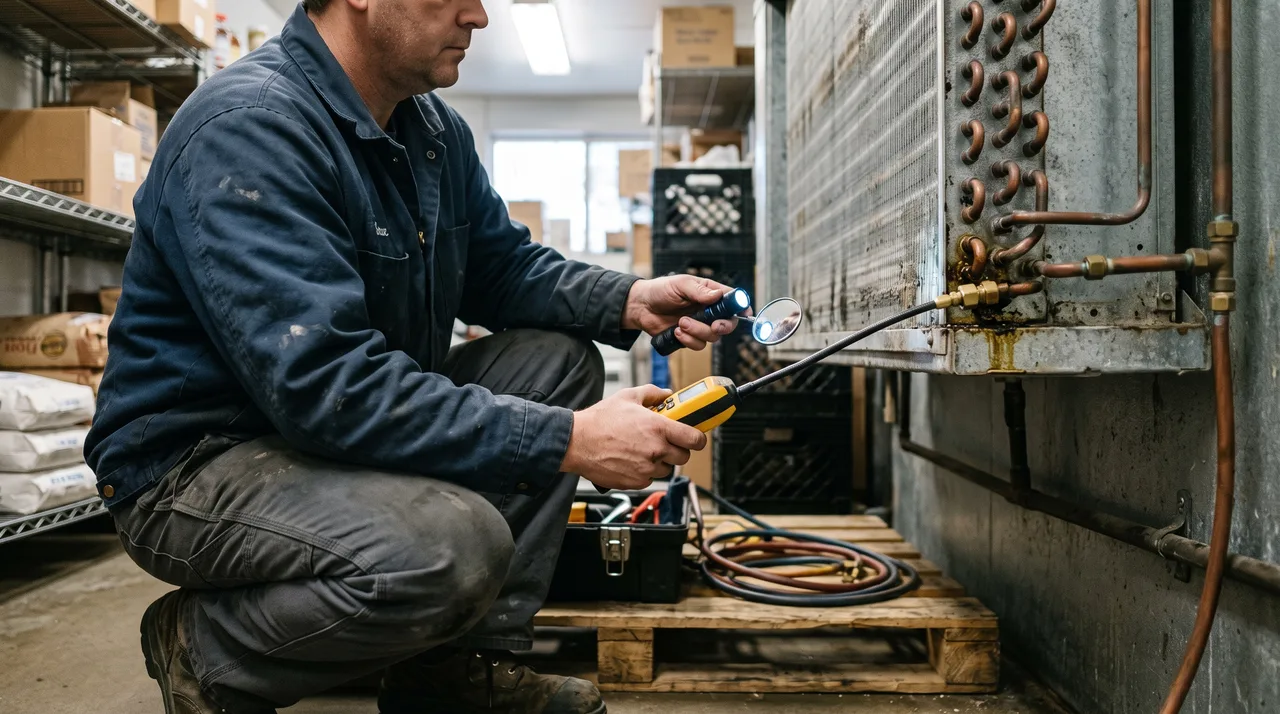
The technician verifies the system is genuinely low with pressure and superheat readings, then searches systematically: a calibrated electronic leak detector across all accessible joints and components, ultraviolet dye where a system already has it, and, for stubborn leaks, isolating the system and pressurizing with dry nitrogen to hear or bubble-test the leak. Once found, the leak is repaired, a new drier is installed, the system is evacuated to a deep vacuum with a decay test, and the full charge is weighed in.
EPA Section 608 and what it means for your business
Under EPA Clean Air Act Section 608, only certified technicians may open a refrigerant circuit, refrigerant must be recovered rather than vented, and for equipment with a charge of 50 pounds or more, leaks above set annual leak rates (currently 20 percent for commercial refrigeration and 30 percent for industrial process refrigeration) must be repaired, generally within 30 days, with follow-up verification and recordkeeping. Even below that threshold, chronic top-offs are a compliance and cost problem. Commercial Refrigeration Oklahoma City technicians are EPA 608 certified and provide the leak-repair and verification records the rule expects.
R-22, R-448A, and the A2L transition
Many Oklahoma City coolers still run R-22, which has not been produced or imported since 2020; recharging an R-22 leak now means paying reclaimed-only prices that can exceed $100 a pound, which quickly changes the repair-versus-retrofit math. Newer equipment runs R-448A, R-449A, R-404A, or R-134a. New commercial refrigeration is moving to lower-GWP A2L refrigerants under the EPA AIM Act. The technician will tell you what your system uses, what a recharge costs today, and whether a retrofit or replacement is the smarter money over the next few years.
Why 'top it off' keeps failing
A system run low on charge has poor oil return, high discharge temperature, and a compressor doing extra work for less cooling. Every top-off buys a few weeks and adds heat-and-acid mileage to the compressor. Refrigerant added without finding the leak also vents to atmosphere through that same leak, which is both an EPA violation on regulated equipment and money leaking out of the roof. Finding and fixing the leak once costs less than three or four recharges and it protects the compressor.
Insurance and payment
Leak repairs are quoted flat with the diagnostic and leak search applied to the work. If a leak caused a compressor failure or product loss, Commercial Refrigeration Oklahoma City provides the diagnosis, leak-location documentation, and itemized invoice needed for an equipment-breakdown or spoilage claim.
What's included
- Confirmation the system is genuinely undercharged via pressure and superheat
- Systematic electronic leak search across all accessible joints and components
- UV dye reading, or nitrogen pressurization and bubble/ultrasonic search for hidden leaks
- Durable leak repair: reflaring, brazing, valve cores, valve stems, or component replacement
- New filter drier and, where indicated, moisture and acid check
- Deep vacuum to 500 microns with a standing decay test
- Charge by weight to the nameplate, verified against superheat and subcooling
- EPA Section 608 recovery, leak-repair, and verification recordkeeping
Symptoms we get called for
- Box slowly losing temperature over days or weeks
- Oil film or stains at fittings, valve stems, or the compressor
- Hissing at a joint, or ice forming at one spot on a line
- A technician who has 'added gas' more than once in a year
- Frost pattern only partway up the evaporator
- High superheat and low suction pressure on the gauges