Last updated: 2026-09-07
Commercial Refrigeration Oklahoma City repairs refrigerated display cases across the Oklahoma City metro for grocers, delis, bakeries, butcher shops, floral departments, and c-stores. Open multideck cases hold temperature with a carefully balanced air curtain, so most case problems are airflow and defrost: a failed evaporator fan, a frosted coil, a defrost control or heater fault, a clogged drain, or a case-level valve on a rack system. The first visit measures product and discharge-air temperatures, finds the imbalance, and corrects it to health-code holding temperature.
What we do on the first visit
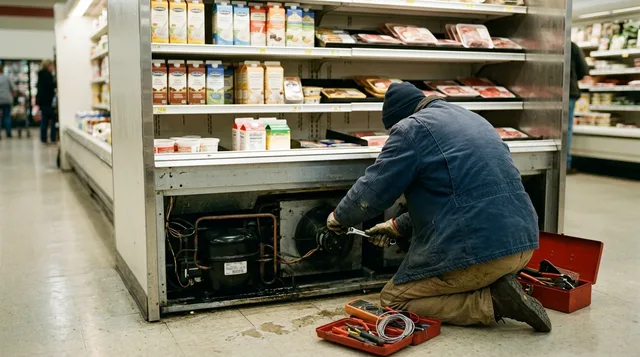
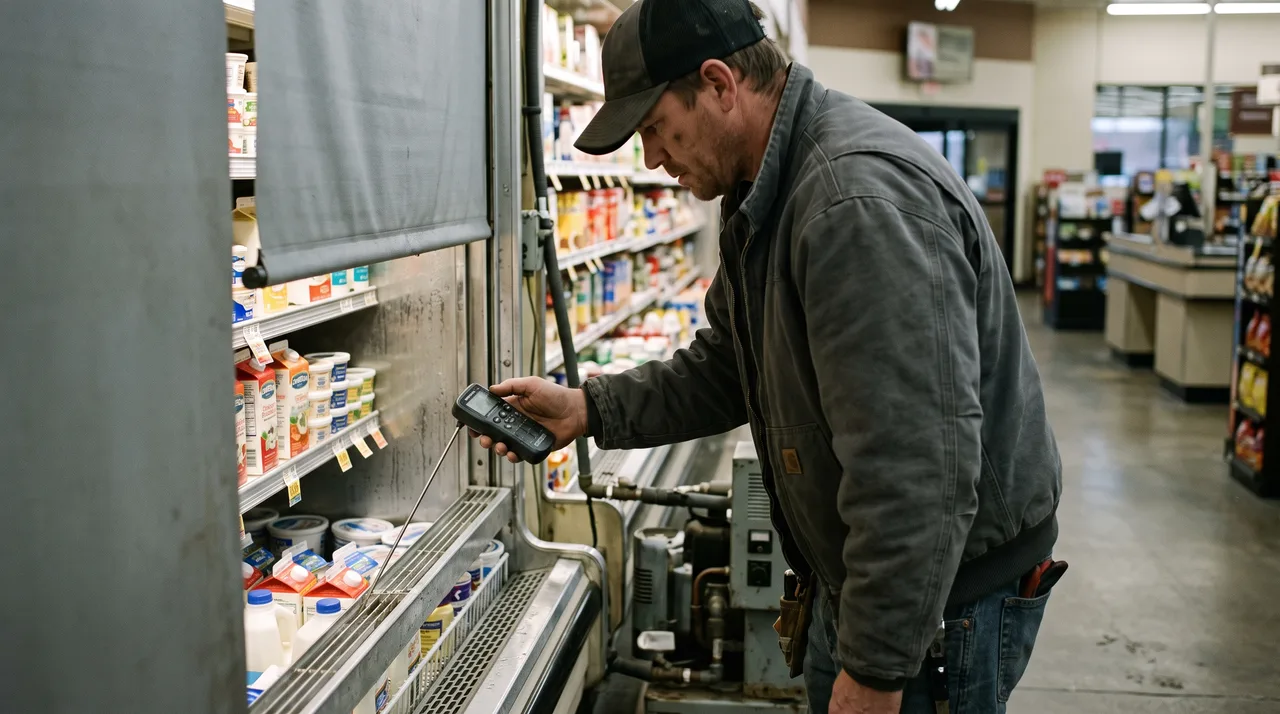
The technician takes product simulator and discharge/return air temperatures, inspects the coil and honeycomb for frost, tests every evaporator fan, checks the defrost schedule and heater operation, clears the drain, and, on rack-fed cases, checks the case's electronic pressure regulator or liquid-line solenoid and the coil's superheat. Fans, controls, heaters, drains, and night curtains are typically same-visit fixes. Case coils and rack valves are quoted in writing.
The air curtain is the whole game on an open case
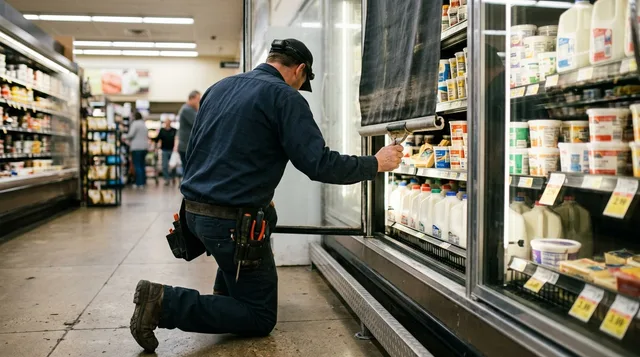
An open multideck case has no doors. It holds 34–40 °F product against a 75 °F store aisle using a laminar curtain of cold air blown from the top and pulled back at the bottom, plus a secondary ambient curtain. If one evaporator fan slows or stops, the curtain breaks, warm store air spills into the case, the coil frosts from that infiltrated humidity, and the bottom shelf goes warm first. The technician verifies every fan's rotation and airflow, checks honeycomb and discharge grille for blockage, and confirms the night curtains deploy, because a curtain fault masquerades as a refrigeration fault.
Defrost on cases: frequent, short, and easy to get wrong
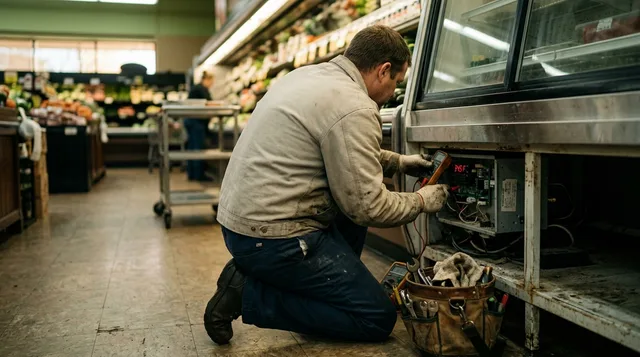
Display cases defrost several times a day on a tight schedule so product never warms noticeably. A drifted coil sensor, a failed defrost heater, or a misprogrammed controller either lets frost accumulate until airflow chokes, or over-defrosts and warms the product on every cycle. The technician reads the controller's live temperatures, ohms and amp-checks the heaters, confirms termination and drain operation, and sets the schedule to the case manufacturer's spec for the product and the store's humidity.
One warm case on a rack
When a single case on a parallel rack runs warm while its neighbors are fine, the rack itself is usually healthy and the problem is at that case: its electronic pressure regulator or evaporator pressure regulator valve, its liquid-line solenoid, a plugged distributor or TXV, a coil that needs cleaning, or its own fan or defrost fault. Diagnosing at the case, rather than chasing the rack, gets that case back to temperature without disturbing the rest of the store.
Insurance and payment
Case failures in grocery and deli settings can spoil high-value inventory quickly. Commercial Refrigeration Oklahoma City documents product temperature on arrival, provides the written diagnosis, and issues an itemized invoice for an equipment-breakdown or spoilage claim. Multi-case and rack projects can be scheduled around store hours.
What's included
- Flat-rate diagnostic quoted before the visit and applied to the repair
- Product-simulator and discharge/return air temperature measurement to health-code standard
- Air-curtain and night-curtain inspection and correction
- Every evaporator fan tested; motors and blades replaced from stock
- Defrost diagnosis: controller live values, heater ohm/amp check, termination, drain
- Anti-sweat and rail-heater circuit testing and replacement
- Rack-fed case valve check: EPR/ESR, liquid-line solenoid, TXV/distributor, superheat
- Written price and schedule for case coils or rack valves that must be ordered
Symptoms we get called for
- Product temperature warm on the bottom or discharge end of an open case
- Heavy frost or ice on the coil, honeycomb, or discharge grille
- Fog or condensation rolling over the air curtain of an open case
- Sweating case front, doors, or mullions on a reach-in case
- One case warm on a rack while the others are fine
- Night curtains not helping, or short-cycling defrost