Last updated: 2026-09-07
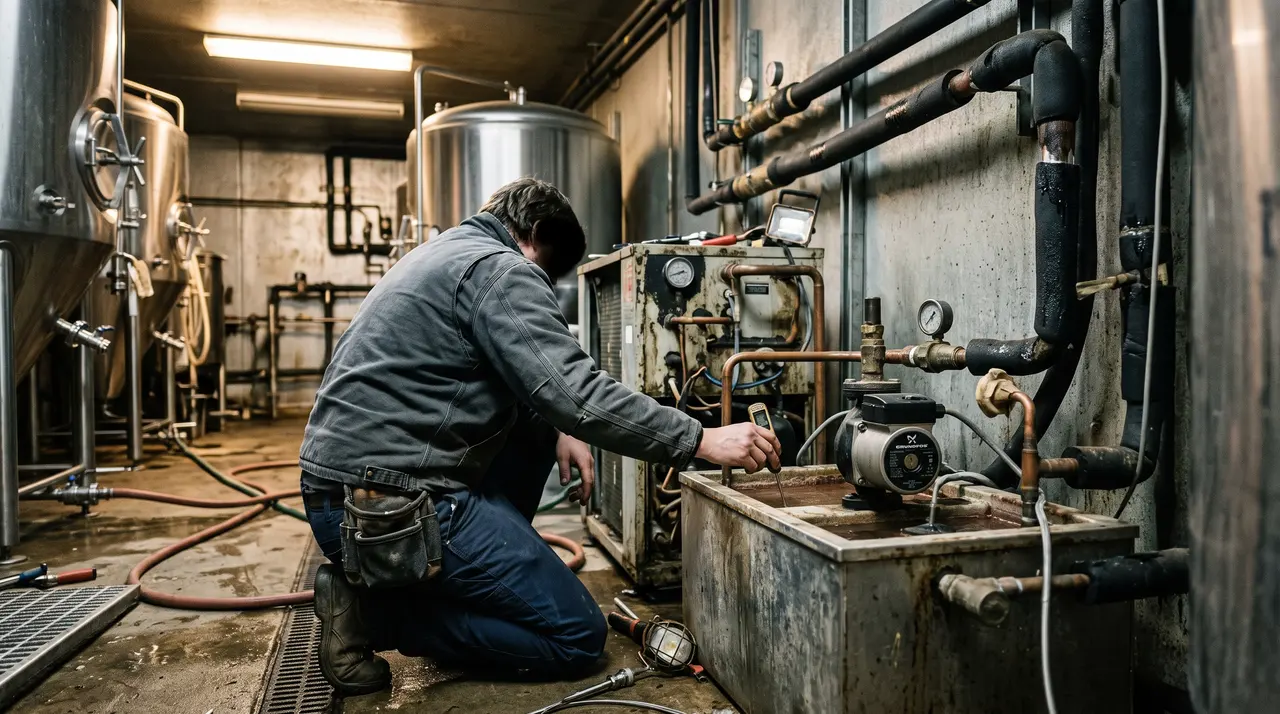
Commercial Refrigeration Oklahoma City repairs glycol refrigeration systems across Oklahoma City for bars and restaurants with long draft runs, taprooms, breweries, and process-cooling users. A glycol system chills a propylene-glycol solution in a bath, then pumps it through insulated trunk lines to keep beer or product cold at a distance. Failures fall into three areas: the chiller's own refrigeration circuit, the circulation side (pump, flow, air), and the distribution side (trunk-line insulation, balancing, manifold). The diagnosis covers all three and is judged by temperature at the point of use.
What we do on the first visit
The technician checks the bath temperature and the chiller refrigeration circuit, tests the circulation pump and flow to each branch, bleeds air, checks the glycol concentration and level, and measures temperature at the farthest point of use. Pump, control, and refrigeration-circuit repairs are commonly resolved in a visit; trunk-line re-insulation, rebalancing, and manifold work are quoted per site.
The chiller bath and the ice trap
A glycol chiller keeps a reservoir of glycol solution near 28–30 °F using a refrigeration coil in the bath and an agitator. If the glycol concentration is wrong, the agitator fails, or the refrigeration control lets the coil run too cold, the bath ices around the coil, insulates it, and the bath temperature paradoxically rises. The technician checks concentration with a refractometer, verifies agitation, and sets the refrigeration control so the bath holds set point without forming an ice ball.
Circulation and the far-faucet foam
When only the farthest bar or the last few faucets foam, the chiller is usually fine and the problem is flow: a weak pump, a partially closed balancing valve, trapped air, or a trunk line that has lost insulation or separated from the glycol bundle over a long run. Commercial Refrigeration Oklahoma City measures flow and temperature branch by branch, bleeds and rebalances, and identifies any trunk-line section that needs re-insulating so cold actually reaches the last faucet.
Insurance and payment
For breweries and process users, Commercial Refrigeration Oklahoma City provides itemized invoices and a service record with the target bath temperature, glycol concentration, and flow readings documented for the operator.
What's included
- Glycol bath temperature and refrigeration-circuit diagnosis
- Glycol concentration check by refractometer and top-up or correction
- Agitator and bath-control verification; ice-trap correction
- Circulation pump testing, seal and impeller service, or replacement
- Branch-by-branch flow and temperature measurement
- Air bleeding and balancing-valve adjustment
- Trunk-line insulation and bundle-contact inspection over the run
- Point-of-use temperature verification at the farthest faucet or tank
Symptoms we get called for
- Glycol bath temperature above the 28–30 °F target
- Chiller short-cycling or the evaporator in the bath iced solid
- Weak or no circulation to one or more bars or tanks
- Foam at the farthest faucets but not the near ones
- Pump noisy, leaking at the seal, or tripping
- Brewery bright tanks or fermenters not holding set point